Bonus modes
SG Bumper Cars: Bonus Modes Guide
Five self-contained mini-games with five completely different ideas about what you did wrong. One of them is a road-safety trap wearing a high-score mode as a disguise.
Alongside the 28-level campaign, SG Bumper Cars has five bonus modes that unlock as you progress. Each one plays completely differently: one is a tailgating game that is secretly a trap, one is a lane splitting delivery sprint, one is an illegal PMD race down a park connector, one asks you to drive so smoothly that a tray of teh tarik survives the trip, and one asks for the exact opposite. Controls are the same as the main game (see the How to Play guide); everything else changes.
All five share one HUD layout, so the meters sit in the same place whichever mode you are in, and every meter is explained on a briefing screen before your first run. You can reopen that briefing any time from the mode's card with "How this works". Each mode also has its own global leaderboard board, so a good run posts somewhere, and any of those scores can be thrown at a friend as a Kaki Duel.
Unlock order
| Mode | Unlocks | In one line |
|---|---|---|
| Tailgate Champion | After Level 3 | Hold the perfect following gap while the car ahead brake-checks you. |
| Lane Splitting | After Level 7 | Delivery rider on a kapcai, filtering through expressway traffic against the clock. |
| PMD Grand Prix | After Level 10 | 2 AM checkpoint race on a park connector, dodging LTA officers. |
| Mabuk Express | After Level 14 | Private-hire shift where the uncle's pedal-pumping "fuel saving" trick leaves the back seat queasy. |
| Teh Tarik Run | After Level 25 | Carry a tray of scalding cups across JB without spilling a drop. |
Tailgate Champion: the tailgating game that tailgates you back
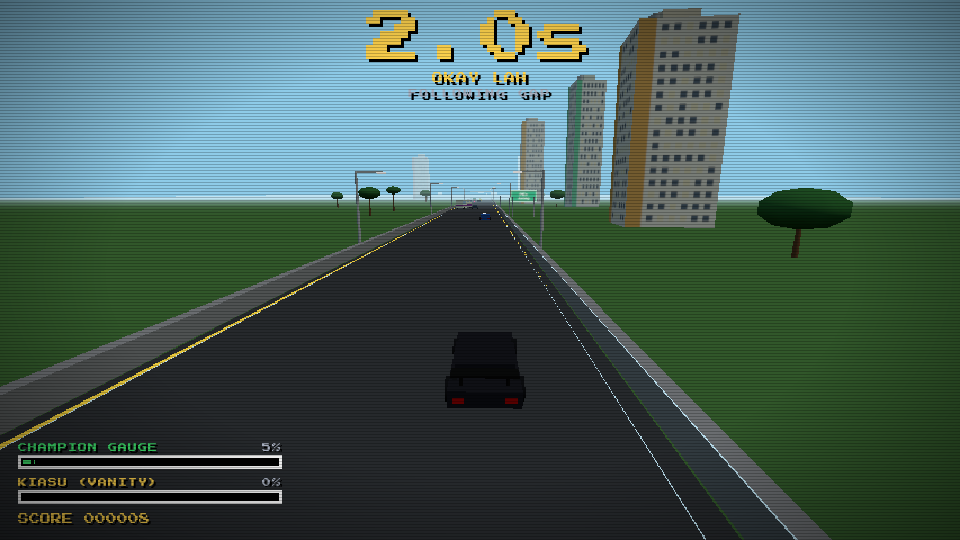
The name is the bait. A big KIASU METER fills fastest when you ride the lead car's bumper, and the mode dares you to chase it. The catch: the car in front brake-checks at random, and the game models your own real reaction delay, the lag between stomping the brake and the car actually slowing. Sit close enough and physics has already decided the outcome; you rear-end, you kena, run over. In effect it is a reaction time test dressed up as an arcade mode: it puts a number on the gap between what you see and what your car does. The meter that actually wins the mode is the Champion Gauge, and it only fills while you hold a proper following gap: the 3-second rule when it is dry, and a much longer gap once the rain comes down.
The two sub-modes
- Driving Test: a graduation gauntlet across dry, night and rain stages. Fill the stage gauge and survive the brake-checks without a rear-end collision to graduate.
- Endless Kiasu: unlocked when you pass the Test. No finish line, ramping difficulty, bank the highest score you can before the inevitable.
Tips
- Ignore the Kiasu Meter. It is labelled vanity for a reason.
- Count the gap off a road marking: pass it 3 seconds after the lead car and you are in the champion zone.
- When the lead car surges ahead, do not chase. The surge is bait for the next brake-check.
- In rain, add distance before you think you need it; braking distances stretch further than the visibility does.
The lesson underneath: tailgating is unwinnable against your own reaction time. The reaction time and stopping distance section of the Road Safety Facts page has the real numbers on how far you travel before you can even start to brake.
Lane Splitting: fast tips, faster consequences
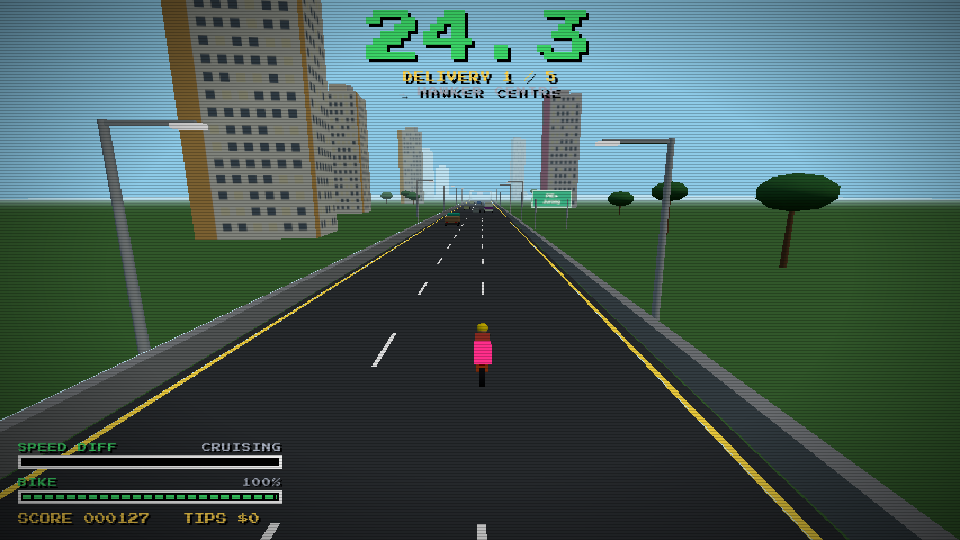
You are a food-delivery rider on a kapcai, threading the dotted line between lanes of a busy expressway to beat a delivery countdown. Reach each drop before the timer dies and the tips stack up; ride clean and they get fatter.
The scoring twist is speed differential: points scale with how much faster you ride than the traffic around you, and so does the damage. A love-tap while flowing with the pack chips a little paint; the same clip while screaming past at full throttle can end the run in one hit. That mirrors the real research on lane filtering, which is only relatively safe at low speed differences.
Tips
- Filter the line between the centre and right lanes first; it is where you start and where the gaps read most cleanly.
- Surge past slow packs, then drop back near the flow speed to bank your distance before the next surge.
- Mirrors, then gap: a car drifting toward the line closes your corridor faster than you can brake out of it.
PMD Grand Prix: 2 AM on the park connector
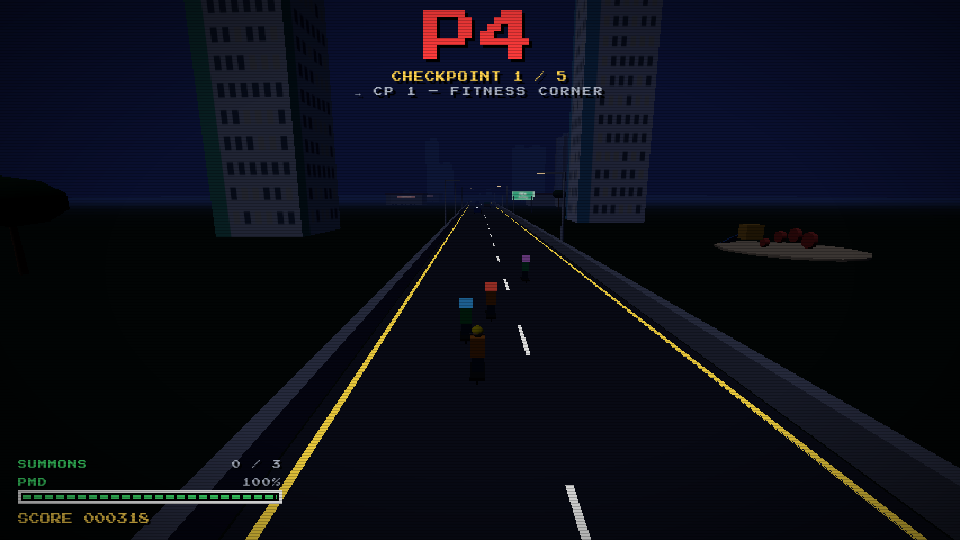
Four uncles, four PMDs, five checkpoints, about 3 km of empty park connector, and kopi money on the line. It is completely illegal, which is why LTA enforcement officers keep stepping out of the bushes with torchlights. Clip one and you are stopped for a summon; collect three summons and the race night is over, disqualified.
You cannot win on throttle alone: the rival uncles rubber-band, so the race stays close to the last leg. What decides it is how cleanly you thread the officers and the sleepy night traffic. There is a global leaderboard for this one, so a clean race is worth real bragging rights.
Tips
- Treat officers like walls, not slaloms. One summon is a time loss; three is the whole night.
- The legs get longer toward the end, and that back half is where positions actually change. Save your cleanest riding for it.
- Racing the rivals into a torchlight is how they beat you. Let them take the risk; take the line they leave open.
Mabuk Express: the pedal-pumping myth, priced
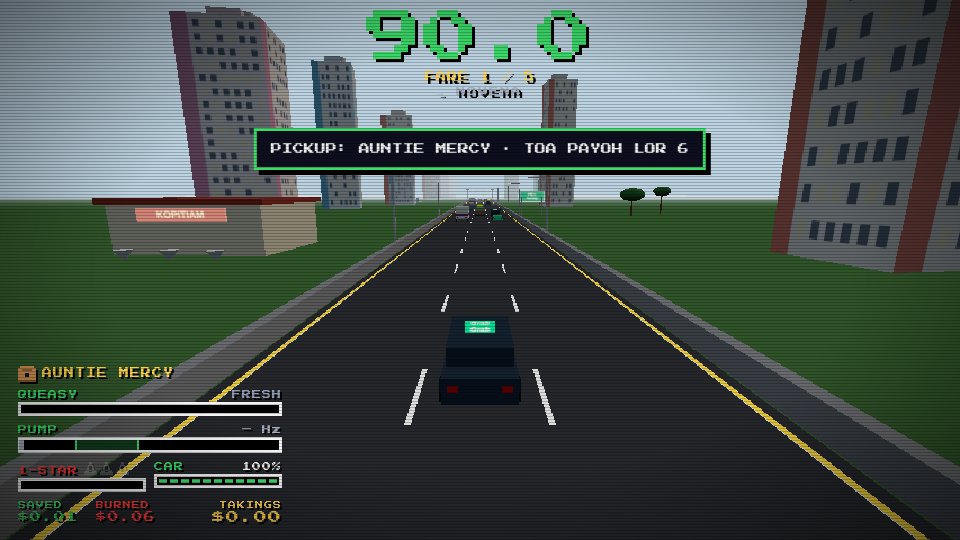
The newest mode, and the one that unlocks once DEXTER is settled and his old private-hire shift becomes yours. Your mentor is the Pump Uncle: thirty years of pressing and releasing the accelerator because "pumping saves petrol". That is the cover story. The real business is in the back seat, where a passenger who blows is a cleaning fee.
The habit is real. A clip of a Singapore private-hire driver's foot jabbing the accelerator over and over went viral, and commuters piled in with the same complaint about accelerating and braking on repeat. The belief behind it is a leftover from carburettor engines, which had no deceleration fuel cut-off, so a closed throttle really did dribble fuel away. Modern injection engines do the opposite: lift off in gear and fuel delivery drops to zero. Jabbing the pedal re-injects on every stab and re-accelerates the whole mass of the car again and again, so pumping burns more. The HUD runs the uncle's imaginary savings next to the real burn, and the results ledger prices the difference.
The twist: resonance, not mashing
Where the Teh Tarik Run rewards calm, this mode is its exact mirror and weaponises the lack of it. Motion sickness peaks at around 0.2 Hz of fore-and-aft oscillation, roughly one surge every five seconds, which is why the PUMP meter gives you a lit window to aim at rather than a bar to fill. That marker reads two things at once: its position is your rhythm, its height is how hard the car is actually surging. A short marker means the pedal is moving but the car is not, and nothing happens.
What can end the shift
- 1-STAR: you want passengers queasy, never alarmed. Hard braking, swerves, scrapes, horn abuse and running late are all things they can name in a report. Fill it and you take a $100 fine and a complaint pip; three pips and LTA suspends your vocational licence.
- The audit: claim too greedily and ops asks for the professional cleaning receipt. Forge it for an instant pass and risk the account, or withdraw the claim and keep your hands clean. Never forge one and the Clean Hands Bonus multiplies your takings.
- The car: nothing repairs it across the whole five-fare shift, and wrecking it with a passenger aboard voids everything you earned.
Tips
- On a phone the pedal scheme flips: the car coasts by default and the left button is your accelerator, because a mode built on releasing and pressing cannot work with the throttle held down forever.
- Count five seconds between surges. Faster is not better here, and mashing the pedal only fills 1-STAR.
- There is an honest line through it. Leave every passenger fresh, arrive on time, take zero complaints, and the five-star Smooth Operator shift out-earns a mediocre run of the whole queasy business. Nobody says so out loud; the ledger just shows it.
Teh Tarik Run: the smoothness game
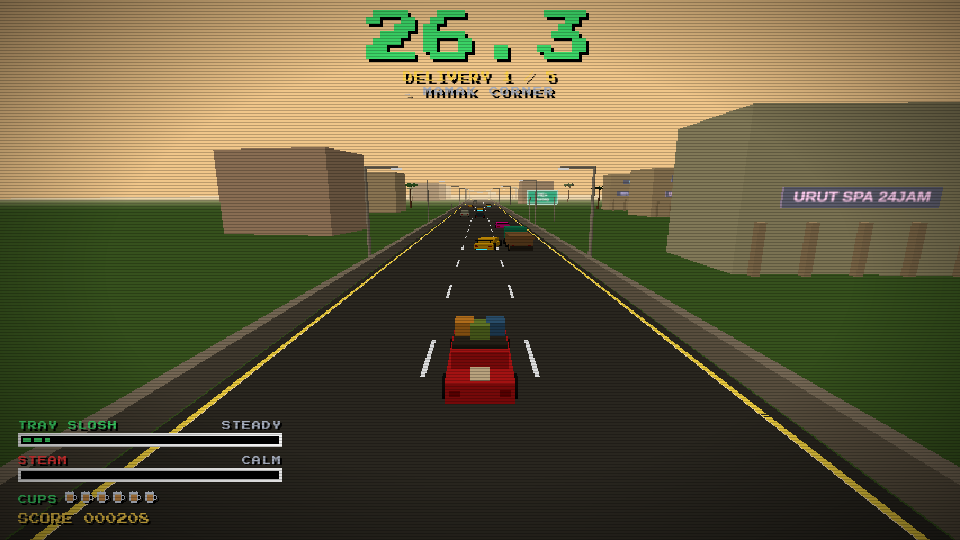
The Malaysia mode, played in your Kampung Rocket, a JB Proton Saga with a tray of full, scalding teh tarik on the passenger seat. Deliver each order across town before it goes cold. The tea is simulated: the surface tilts with every acceleration, so every hard brake, angry swerve and clipped kerb sloshes the cups, and a spilled cup is a cup you do not get paid for.
Two things stack against your calm. Steam is road rage: queue-cutters potong into your gap in the crawl segments, and the angrier you get, the twitchier your hands, the more you spill (the horn vents a little steam, but the jolt shakes the tray). And at the police roadblock comes the duit kopi choice: pay the coffee money in ringgit for an instant pass and risk an SPRM integrity sting, or take the saman, lose a few seconds, and keep your hands clean. Refuse every bribe for the whole run and the Bersih Bonus multiplies your takings.
Tips
- Brake early and gently; the tray forgives one smooth stop, never a panic stop.
- In the crawl, accept the queue-cutter. Two seconds lost costs less than a sloshed tray.
- Take the saman. The Bersih Bonus out-pays every bribe, and the sting risk is real.
Ready to try them? Play SG Bumper Cars free in your browser, no download needed, on desktop or mobile.